.png?w=1920&q=75)

Something is interesting happening across the tech world. Even with new frameworks and tools appearing every year, one name continues to hold its ground—React.js. Whether someone runs a fast-moving startup, a big enterprise with complex systems, or a team that’s hiring the best developers, React still finds its way into the conversation. And this isn’t happening by accident. 2026 hasn’t suddenly changed what companies look for in their digital products—they still want speed, long-term reliability, easy updates, and something their teams can handle without constant struggle. React quietly fulfills all of these expectations without becoming overly complicated or outdated.
Let’s break down why React.js continues to be a smart choice this year and why businesses still rely on it, whether they are working with a Frontend Development Company or handling everything in-house.
Why 2026 Is a Crucial Year for Choosing the Right Tech Stack
As digital experiences become more advanced, 2026 is emerging as a milestone year where businesses must rethink their tech choices to stay competitive. The rapid growth of AI, automation, and high-performance frontends means outdated tools can slow down innovation and increase long-term costs. Selecting a stable, future-ready stack now ensures smoother development and better user experiences.
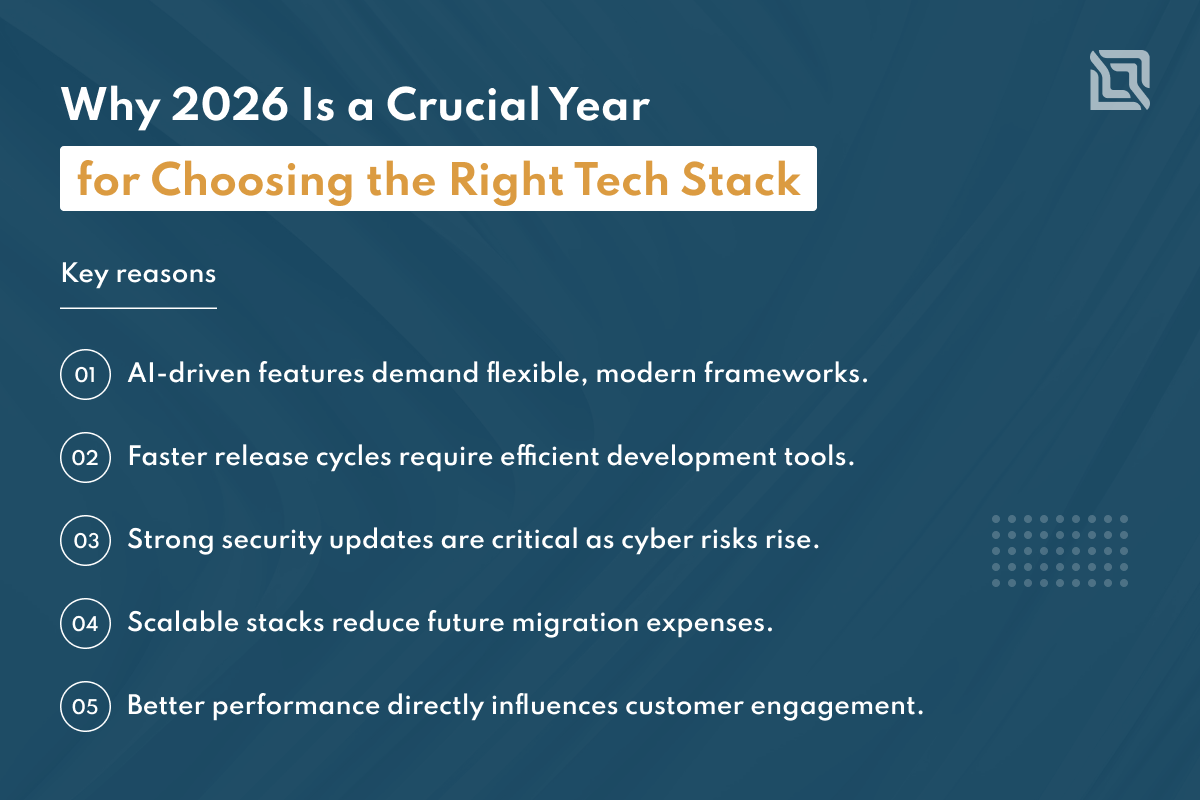
Key reasons:
- AI-driven features demand flexible, modern frameworks.
- Faster release cycles require efficient development tools.
- Strong security updates are critical as cyber risks rise.
- Scalable stacks reduce future migration expenses.
- Better performance directly influences customer engagement.
And when you look at the technologies that meet these rising expectations, one framework continues to stand out for its stability and long-term reliability—React.
1. React Isn’t Trendy—It’s Stable, and That Matters More in 2026
Many tools shine for a year or two before getting replaced by newer ones. But React has turned into something much bigger than a trend. It has become a dependable base—the kind that doesn’t require companies to rebuild everything every few years.
This stability means:
- You don’t have to worry about your app suddenly becoming outdated.
- Your developers don’t need to learn a brand-new tool every time a project begins.
- Businesses can plan long-term without fearing unexpected rewrites.
Most CTOs value stability more than anything else, and React provides exactly that.
2. Developers Still Love Working With It
A framework survives only if developers enjoy using it. After all, they are the ones building products every day.
React stays popular because it’s:
- Easy to learn for beginners
- Flexible enough for experienced developers
- Supported by thousands of reusable components
- Backed by a community that solves issues quickly
No matter how big or small the company, having a framework that people enjoy working with reduces stress, speeds up development, and cuts hiring challenges. Tech recruiters already know this—which is why job descriptions still mention React as a must-have skill.
Companies also find it easier to work with a Frontend Development Company that uses React because the technology has a steady talent pool. This makes projects smoother and less dependent on rare expertise.
3. React’s Ecosystem Has Quietly Become One of Its Biggest Strengths
One thing that doesn’t get discussed enough is just how wide and mature React’s ecosystem has become. Here’s what this really means:
Instead of starting from scratch every time, developers get ready tools for routing, animations, testing, performance tracking, and more. This cuts down weeks of effort and ensures the app behaves consistently.
2026 is the year when businesses value “speed to market” more than ever. A richer ecosystem means apps launch faster without compromising on quality.
A Frontend Development Company offering Frontend Development services naturally benefits from this ecosystem, and so do businesses hiring them.
4. React Makes Apps Load Fast—and People Notice
Whether you run an e-commerce store, SaaS dashboard, or marketplace, people expect everything to load instantly. Slow apps get abandoned within seconds.
React handles this well because:
- It updates only the parts of the page that need changes
- It reduces unnecessary processing
- It keeps the UI smooth even during heavy tasks
This may sound technical, but the benefit is simple: users feel the app is faster and easier to use.
In 2026, when digital attention spans are shrinking further, speed isn’t just nice to have—it directly affects sales, trust, and long-term growth.
5. React Works for Large Apps Without Becoming Messy
A small website can run on anything. The real challenge starts when apps grow—more features, more users, more pages, more complexity.
React handles large-scale growth better than many newer frameworks because:
- Its component-based structure keeps things organized
- Teams can work on different pieces without breaking others
- It’s easier to test and update specific sections
For enterprises, this is a huge advantage. They don’t need to rebuild entire systems every time they add a new module. And for startups, it ensures the product can grow smoothly as the user base scales. This is one reason why many companies still trust a Frontend Development Company that specializes in React, because scaling becomes much more predictable.
6. React Keeps Improving Without Forcing You to Change Everything
Some frameworks evolve in a way that forces teams to rewrite large parts of their code. React does the opposite. It upgrades gradually, so your existing apps continue working while you adopt new features at your own pace.
Recent improvements like Server Components, improved rendering methods, and better developer tools are examples of enhancements that don’t break old projects.
This means businesses avoid:
- Expensive rewrites
- Long downtime
- Hiring additional experts for migration
- Unexpected project delays
React gives freedom to upgrade only when the team is ready.
7. React Plays Well With Backend and Third-Party Tools
Modern applications connect with many things—payment systems, analytics tools, backend APIs, marketing platforms, chat widgets, and more. Some frameworks struggle here because they are designed with tight rules.
React is flexible. It connects with almost anything without drama.
This flexibility helps companies:
- Build apps with mixed technology stacks
- Integrate new tools easily
- Add features without rebuilding the core
- Work with backend teams smoothly
A React.js Development Company or any team offering React.js Development Services benefits from this because the framework doesn’t limit creativity or integration choices.
8. The Talent Market Strongly Favors React Developers in 2026
If a tool is widely used, hiring becomes easier and cheaper. React has one of the largest developer communities, which means:
- Companies don’t face long hiring cycles
- They get developers with different experience levels
- Salaries stay within a reasonable range compared to niche frameworks
- Teams don’t feel stuck with limited resources
This is especially helpful for startups that need to adjust team size quickly or enterprises managing multiple ongoing projects at once. Tech recruiters often prefer candidates with React experience because they can quickly fit into existing teams.
9. React Is Proven Across Industries, Not Just Startups
Many people associate React with fast-moving startups, but its adoption in enterprise environments continues to grow. Banks, healthcare platforms, travel apps, government portals, and large consumer brands all rely on React-based systems.
Why? Because React handles complexity without overwhelming teams.
When a technology performs well across industries, it sends a clear message: it’s reliable, scalable, and safe for long-term investment.
10. React Works Well for Both Websites and Mobile Apps
This part often gets overlooked but is extremely useful for businesses. Choosing React for web development automatically gives an advantage if you ever plan to build mobile apps because React Native uses the same concepts.
This leads to:
- Faster development
- Smaller learning curve
- Shared logic between mobile and web
- Reduced long-term cost
For companies planning multi-platform products, React becomes a smart long-term bet.
11. React Offers Better Control Than Many “All-in-One” Frameworks
Some frameworks try doing everything themselves, which sounds great at first. But as the product grows, these strict rules can limit what teams are allowed to do.
React’s approach is different. It gives you a simple foundation and lets you choose the rest, such as:
- State management
- Routing tools
- Styling methods
- Build systems
This freedom allows teams to design systems based on their needs rather than adjusting their needs to match a framework’s restrictions. In 2026, when businesses want customization more than ever, having this level of control helps build unique digital products without unnecessary effort.
12. Learning React Is Easier for New Developers Joining Your Team
Every business wants developers who can become productive quickly. React’s learning curve is friendly because:
- It feels close to regular JavaScript
- Concepts are simple once explained well
- Documentation is clear
- Community answers are easy to find
This reduces training time for fresh hires and helps teams avoid unnecessary slowdowns. It also ensures that even if team members leave, others can jump in without chaos.
13. React Supports Long-Term Projects Without Lock-In
A major concern in long projects is getting locked into a tool that becomes outdated or too rigid. React avoids this by being flexible and component-focused.
If your project grows to the point where you want to change parts of the system, React still supports that. You don’t need to start over—you can replace only the pieces you want to improve. This longevity is one of the biggest reasons enterprises rely on it.
14. React Is Cost-Effective for Businesses in the Long Run
When companies compare frameworks, they often focus on immediate development time. But the real cost comes from maintenance, hiring, updates, security fixes, and long-term scaling.
React reduces all these costs because it’s:
- Easier to maintain
- Easier to scale
- Easier to hire for
- Less risky to upgrade
- Less dependent on rare experts
A Frontend Development Company offering Frontend Development services also charges more predictably for React projects because they already know how the ecosystem behaves.
Integration With Emerging Technologies
React continues to stay relevant because it easily connects with the new technologies that are shaping the future. As AI becomes a part of everyday applications, React works smoothly with AI tools and APIs, making it possible to add features like smart search, chatbots, or personalized suggestions without heavy changes in the code.
React also pairs very well with headless CMS platforms and API-first systems. This setup helps developers manage content more easily, improve website speed, and build pages that can be updated quickly. Tools like Strapi or Contentful blend effortlessly with React, making the whole process simpler.
In addition, React is slowly becoming a strong choice for Web3 and immersive experiences. Whether it’s basic blockchain interactions, 3D visuals, or interactive elements, React’s growing library support makes these features easier to build.
Overall, React’s ability to adapt to new technologies ensures that it remains useful and future-ready, no matter how quickly the digital world changes.
Use Cases Where React Shines in 2026
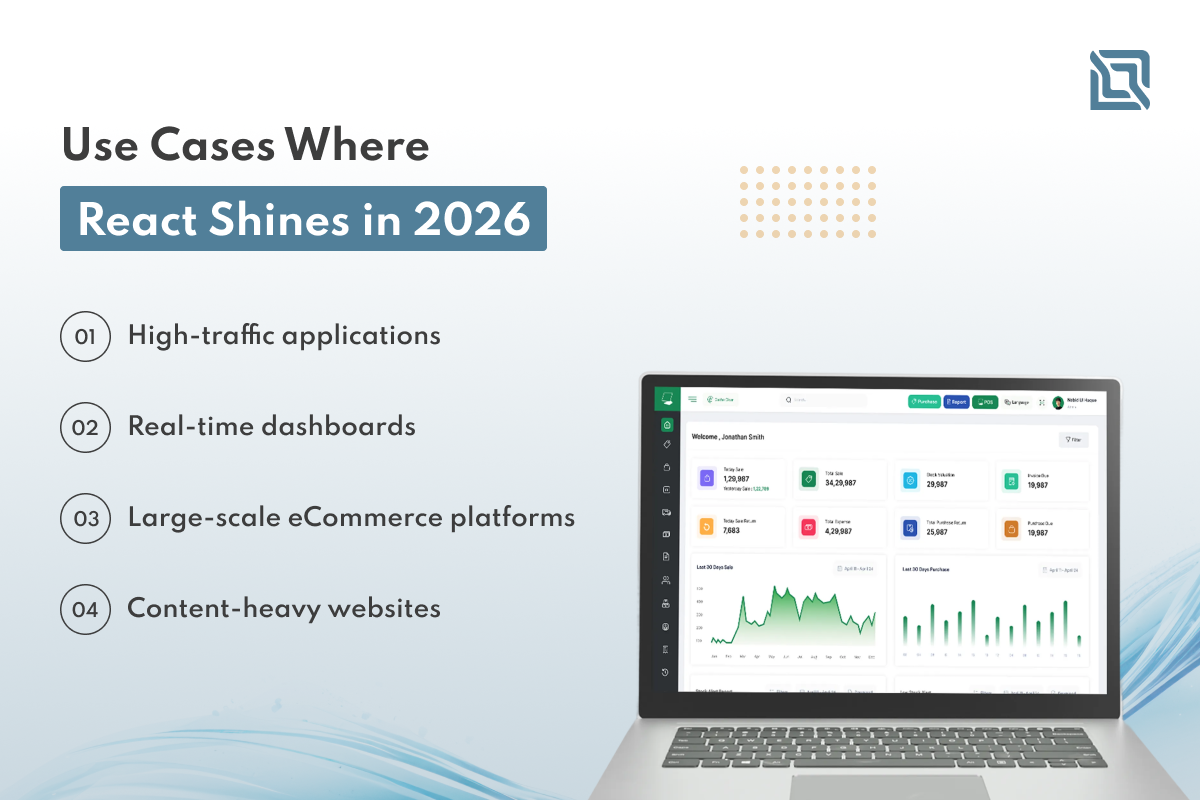
React continues to be a top choice in 2026 because it handles demanding and modern web requirements with ease. Its speed, flexibility, and smooth performance make it suitable for a wide range of use cases.
- High-traffic applications:
React is great for websites and apps that receive a large number of visitors. Its efficient rendering and strong ecosystem help maintain fast loading times even during peak traffic. - Real-time dashboards:
For dashboards that update every second—like analytics, finance, or tracking tools—React offers quick UI updates without slowing the page. This makes data easy to monitor and interact with. - Large-scale eCommerce platforms:
eCommerce sites need fast pages, smooth navigation, and reliable performance. React supports all these needs while offering reusable components, making development quicker and more consistent. - Content-heavy websites:
Blogs, news portals, and knowledge bases benefit from React's ability to load content efficiently. It handles dynamic sections and frequent updates without affecting user experience.
Overall, these strengths make React a dependable choice for complex and fast-growing projects in 2026.
Conclusion: React Still Makes the Most Practical Sense in 2026
Even though many new frameworks will continue appearing in the coming years, React remains one of the safest and smartest choices for web development. It’s stable without being outdated, modern without being complicated, and flexible without being messy.
- Startups appreciate how fast it helps them move.
- Enterprises appreciate how well it handles large systems.
- Recruiters appreciate the large talent pool.
- Developers appreciate the simplicity and comfort.
- And businesses appreciate the long-term reliability.
Whether you’re building something new, upgrading an existing platform, or looking for a partner like a React.js Development Company offering React.js Development Services, React continues to be a dependable foundation for your product in 2026 and beyond.